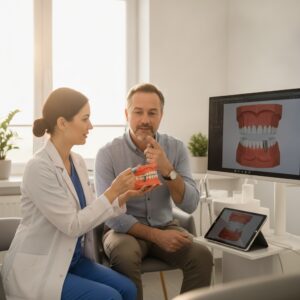
If you’re missing most or all of your teeth, you may be asking, “Why should I consider full mouth dental implants?” This article explains what full mouth dental implants are, who is a good candidate, the benefits, the typical treatment steps, risks and recovery, and how to choose a skilled provider. Read the sections below to get a clear picture and simple next steps.
What Are Full Mouth Dental Implants?
Full mouth dental implants replace an entire upper or lower arch (or both) of teeth with a fixed prosthesis anchored to dental implants. Unlike a single implant that replaces one tooth, full-arch solutions use multiple implants to support a bridge or prosthesis that feels and functions like natural teeth. They differ from removable dentures because they are stable, secured to implants, and usually do not come out daily.
Common terms you may hear include implant-supported bridge (a fixed bridge attached to implants), All-on-4 or All-on-6 (techniques using four or six implants to support a full arch), and fixed hybrid prosthesis (a metal-and-acrylic or porcelain prosthesis screwed to implants). These options restore chewing, speech, and facial support for people who want a long-term solution. The phrase full mouth dental implants describes this full-arch approach.
Who Is A Good Candidate For Full Mouth Dental Implants?
Oral Health And Bone Considerations
Ideal candidates have healthy gums and enough jawbone to hold implants. Years of tooth loss or long-term denture wear can cause bone loss, but many people can still qualify after bone grafting or sinus lifts to rebuild bone where needed.
When Bone Grafting Or Sinus Lifts May Be Needed
If CT scans show insufficient bone height or width, your implant team may recommend grafts or sinus lifts before placing implants. Advances in 3D imaging and surgical guides make planning and grafting more predictable.
Medical And Lifestyle Factors
Medical conditions and habits affect candidacy. Controlled diabetes, careful medication review, and good oral hygiene can allow successful implant treatment. Smoking lowers success rates and slows healing; quitting before and after surgery improves outcomes.
When Other Options Make More Sense
Some patients prefer removable dentures for lower upfront cost or if they cannot undergo surgery. Partial dentures or fixed bridges may be recommended when only some teeth need replacement. Your implant team will discuss realistic goals and alternatives.
Key Benefits Of Choosing Full Mouth Dental Implants
Improved Function
Implants restore stable chewing and clearer speech. Unlike dentures that can slip, implant-supported prostheses let you eat a wider range of foods and speak with confidence.
Bone Preservation And Long-Term Oral Health
Implants replace tooth roots and transmit chewing forces to the jawbone, helping to slow or prevent bone loss. That preserves facial structure and reduces the sunken look that can come with long-term tooth loss or dentures.
Aesthetics And Quality Of Life
Full-arch restorations are designed to look natural. Many patients report better self-esteem, social comfort, and easier daily care compared with dentures.
Cost Over Time
While the initial cost is higher than dentures, implants can be more cost-effective over time by avoiding frequent denture replacements, relines, and ongoing denture adhesives.
What To Expect During The Treatment Process For Full Mouth Dental Implants In Panhandle, TX
Treatment begins with a detailed consult, including a clinical exam, impressions or digital scans, and CBCT imaging to check bone and anatomy. Digital planning helps determine implant placement, prosthesis design, and whether immediate loading is possible.
Treatment planning uses software and surgical guides to place implants precisely. Surgery options include immediate loading—where a temporary prosthesis is attached the same day—or a staged approach that allows healing before the final restoration. IV sedation is available for comfort during surgery.
After implant placement, healing (osseointegration) takes several months as bone bonds to implants. Patients wear a temporary prosthesis during this time. Once integration is complete, the final crown or fixed bridge is delivered. Typical timelines vary but often span 3–6 months from start to finish, with follow-up visits to monitor healing and adjust the prosthesis.
Risks, Success Rates, And Recovery For Full Mouth Dental Implants
Common risks include infection, implant failure, bleeding, and nerve irritation. Careful planning, sterile technique, and prompt management reduce these risks. Most implant systems report high success rates—often above 95%—when patients follow post-op care and maintain good oral hygiene.
Factors that improve success include stopping smoking, controlling systemic health issues, following antibiotics or prescriptions as directed, and attending follow-up visits. Recovery usually involves swelling and mild to moderate pain for a few days, a soft-food diet initially, and gradual return to normal activity. Your implant team will provide specific post-op instructions and a timeline for milestones like switching from temporary to final prosthesis.
Before treatment, ask your implant team about expected success rates, what to do for complications, anesthesia and sedation plans, and who will handle each phase of care.
Technology, Expertise, And Choosing A Provider For Full Mouth Dental Implants In Panhandle, TX
Look for providers with extensive implant experience, training, and patient reviews. Important qualifications include advanced implant training, experience with full-arch restorations, and clear before-and-after case examples. Ask about the team’s comfort with complex cases and emergency care after surgery.
Advanced technology improves outcomes. Key tools include CBCT 3D imaging, X-Nav real-time guided surgery, high-resolution Primescan intraoral scanners, Primeprint in-house 3D printing for surgical guides and temporaries, and digital planning software. These tools increase precision, reduce surprises during surgery, and speed delivery of well-fitting restorations.
Dr. Omar Harmouche, DMD, leads HAR Dental Group and brings national recognition in implant dentistry, IV sedation, and full-mouth restorations. His Tufts training, public health background, and award-winning community service shape a patient-centered approach. HAR Dental Group serves Panhandle, TX and nearby communities with a focus on accuracy, comfort, and long-term results.
Financing and sedation options are available to help patients manage cost and comfort. For your first consult, bring a list of medications, medical history, any recent dental records or X-rays, and questions about timeline, risks, and aftercare.
Next Steps
If you’re considering full mouth dental implants in Panhandle, TX, schedule a consultation to review your scans and options. A local implant team can outline a personalized plan, explain costs and financing, and help you decide if a full-arch solution fits your health and goals.